
Erfoud
Our hotel in Erfoud, Le Palais du Désert, is constructed like a medieval casbah or fort on the outside with turrets and crenelated thick mud walls. Inside it is like an old movie set with furniture like you would see in a Greta Garbo movie from the 1930’s. We even had an old gold trimmed dial telephone that Garbo might have used as a prop in “Grand Hotel.” The hotel website calls this style of room “L’araboclassique.” In fact, the hotel was renovated and expanded when an American movie was being shot nearby and the film studio needed luxurious accommodations for the Hollywood stars. The negative drawback was the lack of hot water in the shower. It was lukewarm at best.
The next day we visited the town of Rissani located on the edge of the Sahara. The town also happens to border the important excavation site of Sijilmassa, an abandoned caravan site that was once the capital of the Alouite dynasty, the ancestors of the current king. Sijilmassa also happens to be where our guide Chloé Capel is the head archeologist. In the middle ages from roughly the 10th century AD through the end of the 16th century trade involved gold and slaves coming from the sub-Saharan empires of Ghana and Mali to the north African states in exchange for salt and other trade goods like beads and cowry shells which at that time were a form of currency.

Chloé at the archeological site in Sijilmassa
One of the most enjoyable visits we made was to Morabit Fossils. According to Chloé, the Erfoud area is a “fossil mecca.” I had noticed strange but beautiful shapes imbedded in the stone countertop in our bathroom at the hotel. Our visit to the fossil “factory” clarified what I was seeing. Mining for fossils and quarrying the stone that contains them has become a major industry in Erfoud, one that is a year-round business, unlike the seasonal harvesting of figs, the second-most important economic activity in the area. Whole dinosaur skeletons have even been dug up. The downside is that the quarry sites are probably being over-excavated and important artifacts are being destroyed.
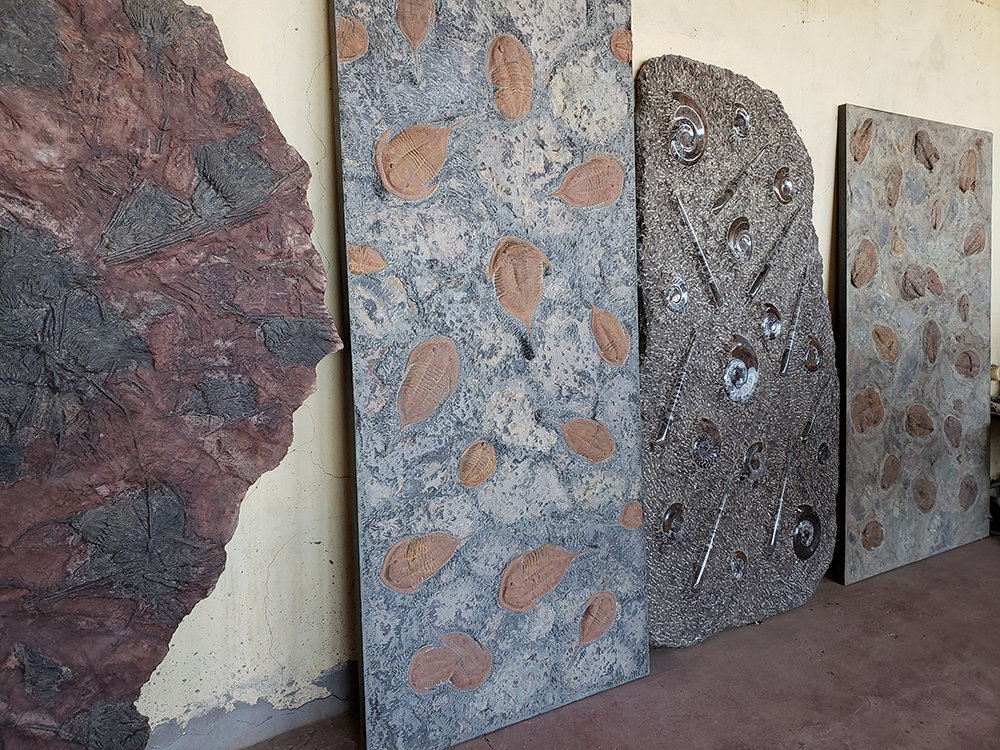
Slabs of fossil embedded stone at Erfoud
I have to confess that the beauty of the quarried stone made me wish we were redoing our upstairs bath like we did 20 years ago. I would have been sorely tempted to use Erfoud’s fossil-embedded stone for the sink and countertop.
Late that afternoon we all piled into 4x4s and headed into the sand dunes of Merzouga on the edge of the Sahara. Our destination was a tented area surrounded by dunes and lots of camels. After being outfitted with the appropriate desert caravan headgear, we each mounted our dromedary camel (the one-humpers) and slowly made our way into the dunes to watch the sunset. I’m not crazy about camels, but I understand their importance to desert folks. Camels just don’t have the charm of horses. Fortunately, our ride only lasted 45 minutes or so.

Mouthy camel, photo courtesy of Steve Harris

Ships of the desert, photo courtesy of Larry Barbour
The sunset, stars and silence of this small bit of the Sahara were awesome. I hadn’t seen stars and constellations like this since we hiked the Inca Trail more than a decade ago in Peru.

Gnawa musicians playing during our tented feast
It was a short camel ride back to the tents. In our absence they had been transformed into a scene from the Arabian Nights. A long runner carpet with Gnawa musicians on either side greeted us as we dismounted leading us into the interior of our tented dining room. It was like a dream but real. The lamb tajine was sublime
On the Road Again
We had another long day on the bus again as we traveled through the High Atlas Mountains to Ouarzazate, Morocco’s Hollywood, with frequent stops along the way. Our first major stop was in Tinehir, a large oasis town with a gorge that rises high into the surrounding mountains. Toudra Gorge is a favorite rock scaling site.
In Tinehir we visited another carpet shop, this one run by a member of the Tuareg tribe. The Tuareg are a subset of the Berbers and have historically been nomads. Their territory traditionally covers the Sahara in Mali, Algeria, Libya, Niger and Burkina Faso. They are sometimes called “the blue men of Mali” because they wear a lot of indigo dyed clothing which rubs off on their skin turning it blue. It’s not easy being a nomad these days, so they have branched out into commerce and even some farming. I used to do a bit of business with them in Bénin several years ago.

A Tuareg merchant displaying a “Tuareg suitcase” made of camel leather, photo courtesy of Steve Harris
The shop had some fantastic tribal Berber rugs, more to my taste than those in the Fez co-op, but I had bought my rug for this journey. However, the shop also carried very interesting, high quality vintage Tuareg artifacts. We did buy a small “Tuareg suitcase” which is basically a leather bag made from camel skin that the nomads use to wrap up their belongings when they move from encampment to encampment. The Tuareg also make very interesting silver and amber jewelry. My bargaining skills were improving.
Although this was a long day of traveling, our guide Seddik’s narrations along the way were very informative. I think he is one of the best-read people I’ve met in a long time. He’s also fluent in five languages. He pointed out the innovative irrigation techniques used by farmers in this desert area. We could see the mounds of wells tracing the aquafer in long lines that crossed the barren landscape. Like the Nabateans in Petra, desert Berber tribes are geniuses with water. Seddik also spoke extensively about the emergence of solar power in Morocco. By 2020 solar energy will provide close to 40% of the country’s electricity. The largest solar energy project in the world is located right outside Ouarzazate where we were headed.

Movie props as décor in our Ouarzazate hotel
An hour or so before dinner we arrived at our hotel in Ouarzazate, Le Berbère Palace. It is a very large hotel and spa decorated with movies props from films shot in Ouarzazate, kind of kitschy, but the décor works. Most importantly, the hotel has a good bar.
We began the next day with a visit to the Atlas Film Studios, the world’s largest film studio. It has been pretty much converted into a museum, but some filming is still done here. “Lawrence of Arabia” was shot in Ouarzazate. Michael Douglas was apparently the first producer to use the Atlas facilities in 1985 when he made “The Jewel of the Nile” here with Kathleen Turner. As you wander through the facility, you can pose in front of the remnants of sets from “Gladiator,” “Ben Hur,” “Star Wars,” and many other mostly epic style movies. Season three of “Game of Thrones” was partly shot here.

The jail cell from “Gladiator” at the Atlas Film Studios in Ouarzazate
Because of the advances made in digital production, there is not as much on-site movie production as in the past. But the Ouarzazate area including the abandoned village of Ait Ben-Haddou is a favorite setting for fashion shoots. In addition to the terrific desert setting, American advertising agencies prefer to shoot in countries like Morocco because they don’t have to pay residuals to the local models.
Most of the rest of the day was spent passing through the High Atlas Mountains on our way to Marrakech. We made a few stops along the way, including one where an old man corralled me into posing with a snake around my neck. I really don’t mind snakes as long as they’re not poisonous. They’re really elegant creatures, unlike camels. In places the road is really steep and some of our fellow travelers suffered from motion sickness.

An artist’s rendition of the Berber Amazigh symbol
One of the topics Seddik raised during our bus ride was the rise of Berber nationalism. Although Berbers (or Amazigh as many people who identify as Berber rather than Arab prefer to call themselves) make up the majority of the population, political control of the country still rests primarily with the descendants of the Arab conquerors. Various iterations of Berber nationalism have arisen in Morocco, including an attempt in the early 1920’s to establish an independent state, the Republic of the Rif, in the northern part of the country. The king and the parliament have been somewhat successful in co-opting the movement by designating Berber an official language and incorporating it into the public education curriculum as well as taking significant strides in making the government secular. I noticed the Amazigh symbol on many buildings. It means “free man.”
While making accommodations to Berber national aspirations, the king and his government are also battling Muslim extremism and fundamentalism. Education for women in general and then allowing them to attend the Sunni religious schools (madrassas) are two of the most important tools for combatting ideologies that threaten this moderate kingdom.
Marrakech
Marrakech is Morocco’s most cosmopolitan city. Its wealth was apparent just riding through the city to our hotel. Many streets are broad boulevards with lots of shops and foreign restaurants. Expensive European cars are everywhere and folks on the streets are well-dressed European style. Our hotel was the Sofitel.

A Majorelle blue planter
The tone of the city is in many ways set by one of its main attractions, the garden and home of the late French fashion designer Yves Saint-Laurent who was born to French parents and grew up in Algeria. The garden which boasts an extensive collection of cacti from all over the world was actually created by the French artist Jacques Majorelle who was the son of noted Art Nouveau furniture designer Louis Majorelle. In 1917 Jacques Majorelle traveled to Morocco to recover from a major illness and fell in love with Marrakech and its light. He eventually settled there and began his garden in 1923, spending the next 30 years or so adding to it. It became his life’s work. He embellished the buildings and objects in the garden in a brilliant cobalt blue that became known as “Majorelle Blue.” In the 1950’s he was forced to sell his property and it fell into disrepair.
In the 1980’s Jacques Majorelle’s masterpiece was discovered by Yves Saint-Laurent and his partner Pierre Bergé. They commenced a major restoration of the property. Saint-Laurent developed an equally striking electric yellow color to complement Majorelle Blue. They converted the ground floor of Majorelle’s villa into a museum to house their collection of Berber folk art and opened it to the public. When Saint-Laurent died in 2008, his ashes were scattered in the villa’s rose garden. Adjacent to the garden is the newly opened Yves Saint-Laurent Museum with mannequins showing off his couture creations. There was a similar exhibition a few years ago in Denver.

A small section of cacti in Yves Saint-Laurent’s garden
I have seen a lot of beautiful gardens in our travels and the Majorelle Garden is one of the best. What I found particularly distinctive about this garden are the complementary colors of the villa and the accessories like the planters scattered throughout. Majorelle Blue has a matte finish, as do the electric yellow and other artificial colors. The matte finish gives the colors a density and clarity that a shiny finish would obscure with reflective light. The artificiality of the colors enhances the natural beauty of the plants, especially the cactus. Cactus have always looked a little contrived and fantastical to me, but they are nature’s fantasy.

The vintage silver dagger with a camel bone handle bargained for in Marrakech
We spent the afternoon shopping in the medina where I was on a mission. A few days earlier I had expressed my concern to Seddik that I wouldn’t be able to find the Gnawa karkaba or castanets I wanted for our grandson and a vintage Moroccan dagger I wanted for our future son-in-law. Seddik kept reassuring me that “if you can’t find it in Marrakech, it doesn’t exist.” He was so correct. I located the karkaba right away. The dagger required a bit more work.
Ali, one of the extra guides Seddik had hired to schlepp us around town, led me to a large vintage artifact shop that had a wall of old daggers. I immediately got into bargaining mode. This salesman and I were in each other’s faces for a good 30 minutes or so while we went back and forth. I kept asking him the prices of various pieces while comparing them to the knife I really had my eye on and he knew it. The price kept going lower and I refrained from making any counteroffers. Finally, he asked the usual question, “What is your best offer?” I looked at him and replied, “You give me your best price.” And he came down to a third of what he had opened with. Sold! None of this settling for half. I was back and getting nostalgic about not having the gallery any more.

Traditional water sellers in Marrakech, photo courtesy of Kristen Anderson
Before returning to our hotel, we had tea on the rooftop of a large restaurant overlooking Djemaa El Fna, the large open square adjacent to the medina where tourists mingle with townspeople to watch performers of all types do their thing from improv skits to snake charming. I didn’t like the macaque monkey handlers. I think it’s cruel. And, of course, we had to pose with Morocco’s iconic water sellers with their big red Berber hats and coin-decorated water bags. Tourists shouldn’t drink this water, but locals often do to bring themselves good luck.
I collect washboards. To me they represent traditional women’s work which is hard, necessary, and undervalued. In the Moroccan countryside we had seen laundry being done by hand, but out of respect for their dignity, we refrained from photographing the women, but I really wanted one of the washboards, preferably used. I didn’t see any in the medina, but before we went back to our hotel, I asked Ali if he could find me one. He said he would try.

The Sofitel Marrakech illuminated at night in magenta
That evening we had dinner on our own at a pretty good Italian restaurant. We had had enough tagine. When we walked back to the Sofitel, it was all illuminated in beautiful magenta lighting. It had been a fantastic day.

Detail of a ceiling in El Bahia Palace
On our last full day in the city we toured many of the traditional tourist sites in Old Marrakech – the Koutoubia Mosque (on the outside only) with its distinctive minaret that dominates the city’s skyline, the ruins of the Palais El Badii, the 19th century El Bahia Palace, and, of course, the Mellah. I was especially impressed by the superb craftsmanship of El Bahia Palace. It was originally built for Si Moussa, a former slave who rose in the ranks to become the sultan’s Grand Vizier, the king’s hatchet man.

My new Moroccan washboard that reminds me of a minimalist abstract painting
Periodically during the day Ali and the washboard kept crossing my mind. I hadn’t seen him, and by the end of the afternoon I figured he hadn’t found one or had forgotten about it. But lo and behold, as we were boarding our bus that evening for another rendezvous, Ali appeared with washboard in hand. It was new and unused, but it was beautiful. I was absolutely thrilled.
That evening before dinner we were bused to the home of a highly regarded university professor for a talk with a local imam about Islam. The imam read a rather lengthy statement describing Islam as practiced in Morocco, basically the “party line” set by the king. The faith advocates for tolerance and dialogue among people of all persuasions. To quote from a recent article in the New York Times, “. . . moderation is both the kingdom’s way to counter the spread of destabilizing extremism in a country where many have been tempted by the Islamic State, and to turn Morocco into a center for Islam in Africa.” (March 31, 2019)
Moroccan Sunni Islam has been greatly influenced by Sufism which with its emphasis on an individual’s relationship with Allah rejects the rigidity of fundamentalist Islam and encourages the fusion of the secular with the divine, the body with the soul, and local traditions with universal values.
After the imam’s statement, we were encouraged to ask questions. One of our fellow travelers asked if sharia law was still practiced in Morocco. We were told no, but later we were informed by Seddik that the only remnant of sharia law left was that regarding inheritance rights. Apparently, male relatives of the deceased, no matter how distant, are entitled to 2/3’s of the property while female relatives are only entitled to 1/3. Of course, this can be circumvented by a properly executed legal will. Inheritance laws like this have caused major demonstrations by women in Tunisia.
Casablanca

Rainbows of light from the stained-glass windows at Notre Dame de Lourdes Catholic Church in Casablanca
The next morning we boarded our bus for Casablanca, Morocco’s largest city and its economic capital. As if to reinforce the imam’s message of tolerance and dialogue, our first stop in the city was at the Notre Dame de Lourdes Catholic church. Built in 1956, it is one of only two Catholic churches in Casablanca. The outside is nothing remarkable, but the stained-glass windows on the inside are truly spectacular. Designed by French artist Gabriel Loire, they illustrate the different appearances of the Virgin Mary as she has been made manifest throughout the Christian era. The colors of red and blue with the main figures in white and light blue are reminiscent of traditional Moroccan carpets. When you walk down the main aisle, the windows create rainbows of light that are quite transcendent.
This visit was followed by a tour of the Grand Mosque of Hassan II, the current king’s father. It was the only mosque in Morocco we were allowed to enter. It is the largest mosque in Africa and has the tallest minaret in the world. The minaret is topped by a green laser light that is aimed toward Mecca. It was built in seven years between 1986 and 1993. Building it was quite an engineering feat because it was constructed both on land and over the Atlantic Ocean. The mosque can accommodate 25,000 people inside and 80,000 in the square surrounding it. The ceiling of the prayer hall is retractable.
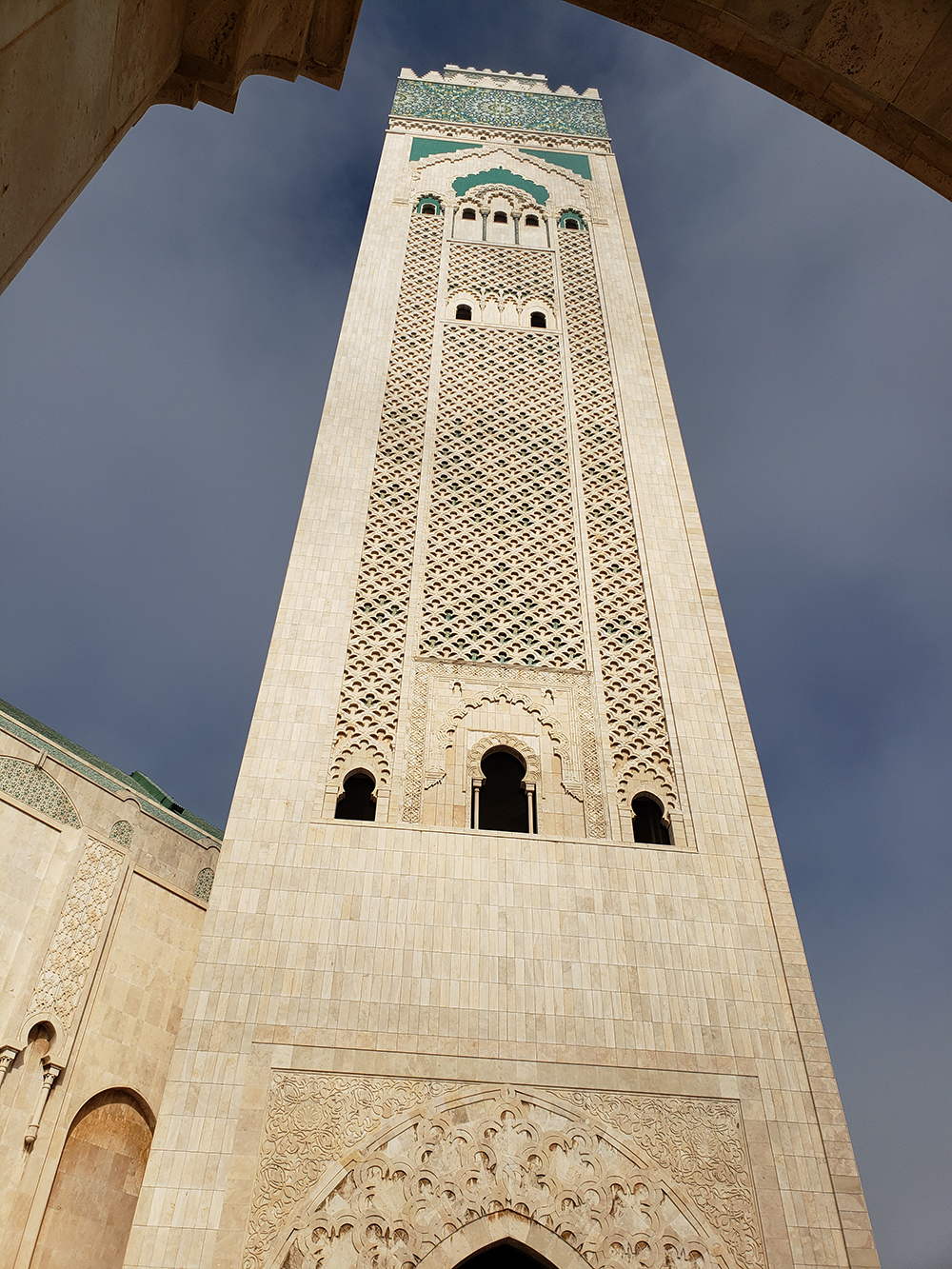
The minaret of the Grand Mosque of Hassan II in Casablanca, the tallest minaret in the world
There is no question that the craftsmanship of the building is exquisite and its construction endowed Casablanca with a world class landmark that it lacked, but its financing was quite problematic. Much of the financing was by public subscription – that is, the entire population was expected to contribute to the cause and apparently did. The total cost of the building has never been revealed.
There is one analysis of its construction that I haven’t been able to verify, but that I think is worth sharing. Hassan II was dying of cancer and was faced with labor problems in Casablanca. He wanted the mosque as a monument to himself and as a diversion from the labor unrest in the city. The mosque served that purpose well. 1400 workers were employed during the day and 1100 at night during the height of its construction. Altogether, 10,000 artists and craftsmen labored on it.

Outside Rick’s Café in Casablanca
Appropriately, we ended our day and our Moroccan journey with dinner at Rick’s Café. This Rick’s Café is actually a fantasy created by a former American diplomat named Kathy Kriger in 2004 who actually had craftsmen recreate the props and setting used on the sound stage where the movie was shot in 1942. It was a lot of fun to be there and the seafood we ate was delicious. Kriger apparently embarked on her project as a reaction to 9/11 when she feared an American backlash to Muslims. As an American, she wanted to build a monument to tolerance in the heart of a Muslim country. I think she succeeded.
Comments are closed.